Top 10 High-Risk Issues for Small Businesses in 2026
A closer look at the top 10 macro risks facing small-and-medium-sized enterprises (SMEs) this year reveals a staggering reality: nearly 70% of your primary operational risks are directly driven by HR, and up to 85% are heavily influenced by workforce behavior, compliance, and culture.
BUSINESS INSIGHTS
5/25/20265 min read


For years, small business owners viewed Human Resources (HR) as a purely administrative department—the team responsible for processing payroll, filing onboarding paperwork, and planning the annual holiday party. But as we navigate 2026, a seismic shift has occurred.
According to the 2026 Allianz Risk Barometer, a global benchmark surveying over 3,300 risk management experts, and the latest ADP HR Trends Research, business risks have become deeply interconnected. Today, experts no longer view HR as an administrative silo; it has transformed into a critical strategic risk-management function.
A closer look at the top 10 macro risks facing small-and-medium-sized enterprises (SMEs) this year reveals a staggering reality: nearly 70% of your primary operational risks are directly driven by HR, and up to 85% are heavily influenced by workforce behavior, compliance, and culture.
Here is a comprehensive breakdown of the top 10 high-risk issues small businesses face in 2026, their surprising human connection, and the actionable solutions required to mitigate them.
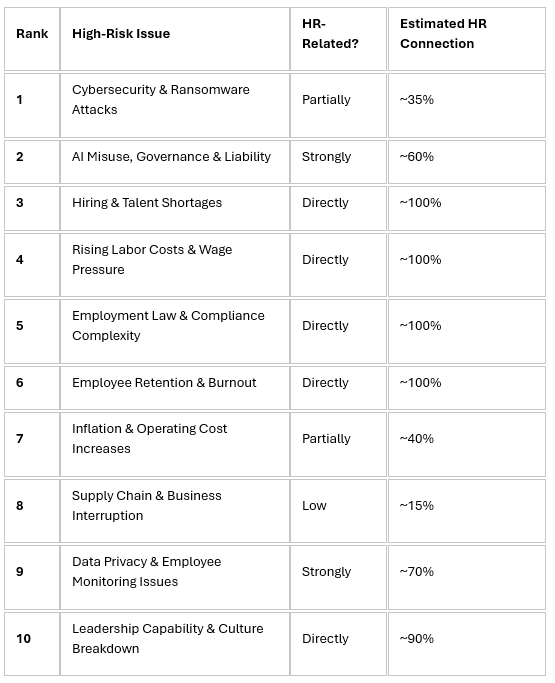
The 2026 Risk Landscape: An Overview
1. Cybersecurity & Ransomware
For the fifth consecutive year, cyber incidents rank as the #1 global business risk. Small businesses are primary targets because they rarely possess dedicated, full-time information security teams.
The HR Connection: Data shows that the vast majority of security breaches begin with a human error—such as an employee falling for highly sophisticated AI-driven phishing scams. Furthermore, loose or unstandardized onboarding and offboarding procedures create severe data-access liabilities. Security is no longer just an IT problem; it is an employee training problem.
2. Artificial Intelligence Misuse & Governance
AI has made the largest leap in risk history, surging from the #10 spot last year directly to #2 globally. Small businesses are rapidly integrated into public and private AI tools, but they are doing so without formal guardrails.
The HR Connection: "Shadow AI"—the unauthorized employee use of unapproved AI tools—runs rampant. HR must manage the fallout, which includes establishing explicit AI usage policies, mitigating bias in automated hiring algorithms, navigating worker anxiety regarding job displacement, and enforcing compliance with rapid new AI disclosures.
3. Hiring & Talent Shortages
Finding qualified, specialized talent remains a painful, persistent operational bottleneck for small firms.
The HR Connection: This risk is entirely workforce-driven. Small businesses struggle to compete against enterprise-level salaries and benefits, meet rising remote-work or hybrid expectations, handle rapid Gen Z turnover, and source skills that match the fast-changing demands of a digital market.
4. Rising Labor Costs & Wage Pressure
Margins are tighter than ever. Small businesses report that ballooning expenses related to wages, mandatory healthcare, benefits, and local payroll taxes are outpacing revenue growth.
The HR Connection: HR directly owns the strategy required to balance this budget. Poor workforce scheduling, inaccurate compensation benchmarking, and payroll calculation mistakes have escalated into severe legal liabilities. According to ADP, payroll errors alone now represent a top systemic risk for smaller firms.
5. Employment Law & Compliance Complexity
Regulatory frameworks are evolving at an unprecedented pace, making compliance the fastest-growing administrative burden for business owners.
The HR Connection: Remote and distributed workforces have forced small businesses to navigate a tangled web of multi-state employment laws, complex worker classification audits (independent contractor vs. W-2 employee), state-mandated paid leave policies, and expanding pay transparency transparency laws. Assuming "we are too small to be sued" is a multi-thousand-dollar mistake.
6. Employee Retention & Burnout
In 2026, the financial cost of replacing an employee heavily outweighs the investment required to keep one. Burnout is a quiet productivity killer.
The HR Connection: Retaining top performers requires highly structured HR initiatives. Modern employees demand transparent career development pathways, workplace flexibility, mental health support, and empathetic leadership. Businesses lacking structured engagement strategies are suffering the highest turnover rates.
7. Inflation & Operating Cost Increases
While inflation and rising vendor tariffs are fundamentally financial issues, their downstream operational impacts are heavily felt within the workforce.
The HR Connection: Macroeconomic inflation drives employees to demand aggressive cost-of-living raises. When small businesses cannot afford these adjustments, they face diminished morale, restricted hiring capacity, localized layoff risks, and trimmed training budgets—all of which degrade long-term organizational health.
8. Supply Chain & Business Interruption
Geopolitical volatility, localized conflicts, and trade disputes continue to stall the delivery of critical components and business assets globally.
The HR Connection: When parts don't arrive, businesses cannot operate efficiently. This directly alters human capital management, forcing leadership to rapidly pivot staffing plans, re-engineer shift schedules, rely more heavily on variable contractors, or execute painful structural furloughs.
9. Data Privacy & Employee Monitoring
The collision of remote work tracking software, biometric entry points, and automated performance analytics has created a legal and ethical minefield.
The HR Connection: If your business utilizes surveillance software or AI-generated performance scoring, you face strict state and global data privacy regulations. HR increasingly owns the responsibility of policing internal data leakages while maintaining ethical, transparent employee data protection boundaries.
10. Leadership & Workplace Culture Failures
Often underestimated, toxic workplace cultures and poor supervisory capabilities serve as major catalysts for business failures.
The HR Connection: Inconsistent management, a systemic lack of documented performance reviews, poor communication, and weak internal accountability amplify every other risk on this list. It drives lawsuits, kills employee retention, and actively stifles productivity.
Strategic Solutions to Mitigate Workforce Risk
To thrive in this environment, small business owners must abandon reactive administration and adopt proactive risk management. Here are four foundational solutions to implement immediately:
A. Transition from Admin to Risk Management
Treat HR with the same legal and financial scrutiny you apply to your corporate taxes. Audit your worker classifications, evaluate your multi-state compliance posture, and ensure every employee action—from disciplinary warnings to terminations—is documented thoroughly.
B. Implement Comprehensive Training and Policies
Build robust operational guardrails. Establish clear, written corporate policies regarding:
AI Governance: Explicitly outline which AI tools are approved for business use and how proprietary client data must be handled.
Cybersecurity Awareness: Conduct regular, mandatory phishing simulations and data-handling training to transform your staff into a defensive firewall.
C. Leverage Modern HR Technology & Automation
Data shows that 70% of small businesses are now exploring or actively deploying AI and automated software specifically for payroll and HR compliance. Integrate your timekeeping, payroll, and benefits systems to eliminate manual data entry errors. Automated compliance tracking helps protect you against catastrophic wage-and-hour violations.
D. Consider Strategic HR and Payroll Outsourcing
If your business lacks a dedicated in-house compliance expert, you are exposed. Partnering with a Professional Employer Organization (PEO) or an outsourced HR provider grants you immediate access to enterprise-grade compliance infrastructure. Studies show that small businesses leveraging outsourced HR models experience up to 27% lower employee turnover and significantly reduced administrative overhead compared to those handling it entirely in-house.
Final Thoughts
The takeaway for 2026 is clear: protecting your small business requires protecting and governing your people. By recognizing that cybersecurity, AI integration, and regulatory compliance are deeply human challenges, small business owners can build resilient organizations capable of weathering any economic storm.
For small business owners in Michigan navigating this complex regulatory landscape, you don’t have to manage these high-risk compliance burdens alone. Convergus VA serves as your dedicated, local HR partner, providing specialized expertise, robust training structures, and tailored risk-management strategies your business needs to stay secure, compliant, and thriving in 2026. Protect your operations from costly penalties and legal vulnerabilities by building a resilient human resources framework today. Let’s have a chat—book a call now to discover how we can safeguard your business!
References & Data Sources
Allianz Commercial, Allianz Risk Barometer 2026: Top Global Business Risks Report
ADP Research Institute, The 2026 HR Trends Small Businesses Can't Ignore & Global Payroll Survey Insights
TechRadar & IT Pro, Macroeconomic & Emerging Technology Corporate Risk Surveys (2025-2026)
contact@convergusva.com
616-795-0928
© 2026 ConvergusVA. All rights reserved.
Call us:
Email us:
Follow us:
Your virtual business partner
Disclaimer: We are neither a licensed tax nor accounting firm and do not provide tax advice. Additionally, we are not a staffing agency or a Professional Employer Organization (PEO) and cannot offer legal guidance. For legal inquiries, please seek advice from a licensed employment law attorney.
Quick Links