The Million-Dollar Mistake: An SMB Guide to the Employee vs. Contractor Line
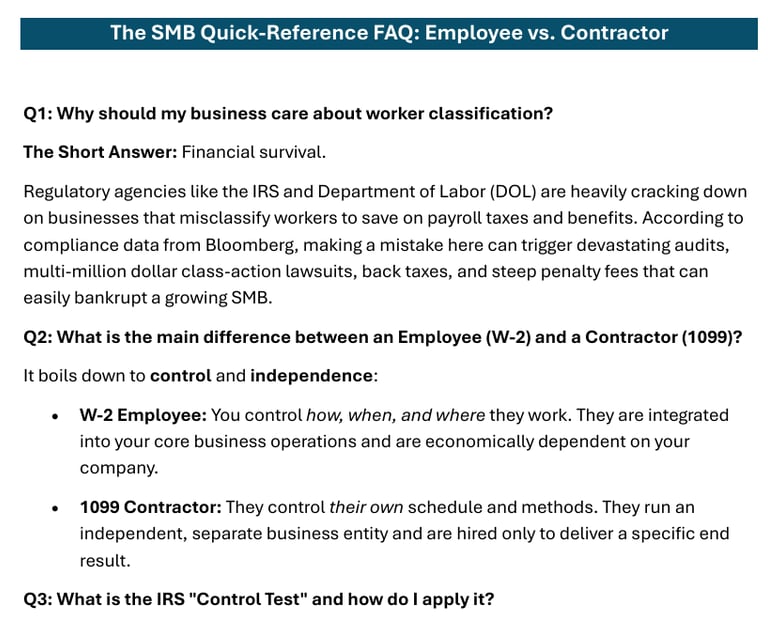
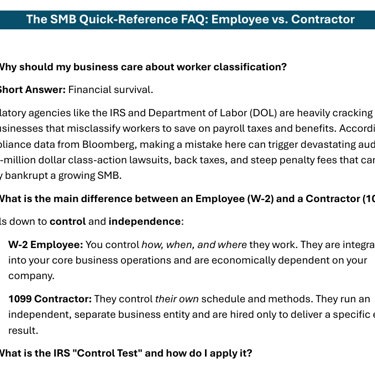
Federal and state regulatory bodies are aggressively auditing smaller enterprises that misclassify their workforce. According to corporate compliance data tracked by Bloomberg, the financial fallout from worker misclassification—including years of back taxes, overtime pay demands, and legal penalties—can completely wipe out an SMB’s cash reserves. To protect your business while maintaining your growth momentum, you need to understand exactly where the government draws the line.
EMPLOYMENT LAW & COMPLIANCE
5/29/20264 min read


As a small or medium-sized business (SMB) leader, agility is your superpower. When a new project lands or your business experiences a sudden growth spurt, your first instinct is often to scale your team as quickly and cost-effectively as possible. It is incredibly tempting to hire independent contractors (1099s) to bypass the overhead of payroll taxes, workers' compensation, and health benefits. However, what feels like a savvy, money-saving shortcut can easily turn into a business-ending mistake.
Federal and state regulatory bodies are aggressively auditing smaller enterprises that misclassify their workforce. According to corporate compliance data tracked by Bloomberg, the financial fallout from worker misclassification—including years of back taxes, overtime pay demands, and legal penalties—can completely wipe out an SMB’s cash reserves. To protect your business while maintaining your growth momentum, you need to understand exactly where the government draws the line. By looking at the core rules defined by the IRS and the Department of Labor (DOL), this guide outlines the critical operational boundaries every small business owner must enforce.
The Core Question: Control vs. Independence
When the IRS and the Department of Labor look at your business, they do not care what label you and your worker put on a contract. You cannot simply have a worker sign a form agreeing to be a 1099 contractor. Instead, regulators look entirely at the daily operational reality of the relationship.
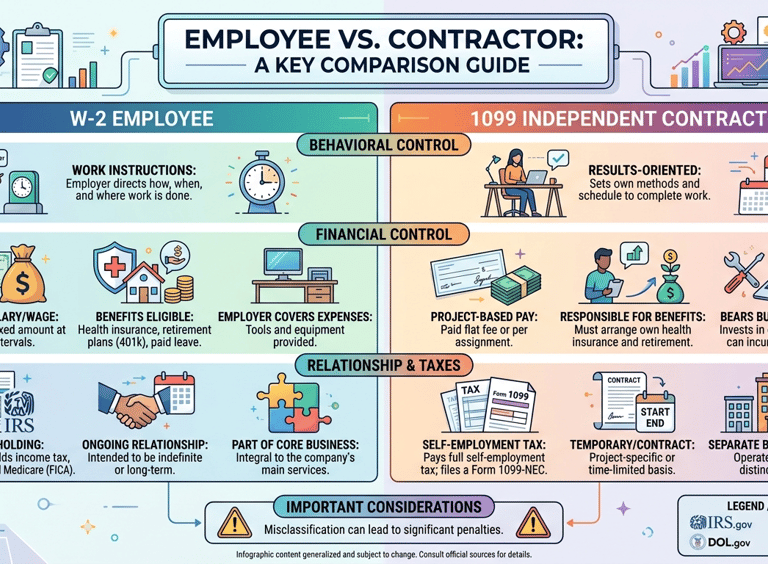
The legal distinction boils down to a single concept: Control. If your business dictates how, when, and where the work gets done, that person is legally an employee. If the worker retains the autonomy to decide their own methods and schedule, they are a contractor.
To help SMEs navigate this safely, the government relies on two primary frameworks: the IRS Control Test and the DOL Economic Reality Test.
1. The IRS "Control Test" for SMBs
The IRS evaluates three specific categories of control to determine if an individual is an employee. As a business owner, you should audit your current team against these benchmarks:
Behavioral Control
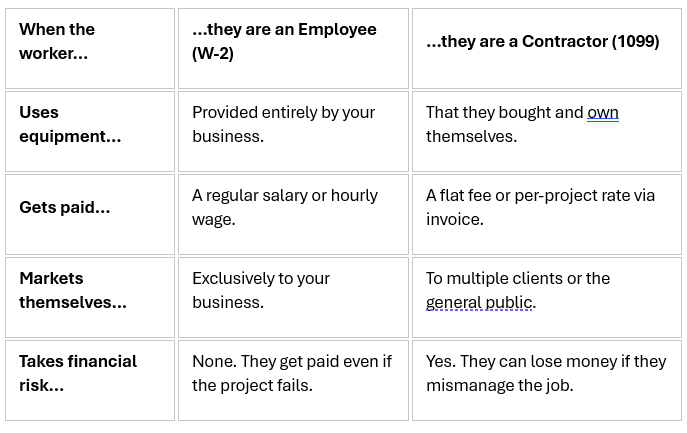
Does your business direct the worker's daily behavior? A worker is almost always an employee (W-2) if you provide step-by-step training, mandate specific hours, require them to work at your office, or tightly supervise how they complete their tasks. An independent contractor (1099) is results-oriented; you tell them what the final goal is, but they choose the tools and methods to achieve it.
Financial Control
How is the money handled? If your business provides the laptop, pays for the required software licenses, and reimburses daily out-of-pocket expenses, the worker looks like an employee. Contractors generally make their own capital investments in their businesses. Furthermore, employees are paid a predictable hourly wage or salary on a set schedule, whereas contractors submit invoices for a flat, per-project fee.
Type of Relationship
How do you interact long-term? If you provide any form of benefits—such as paid time off or health insurance—or if the relationship is open-ended with no defined end date, the IRS views them as an employee. Contractors are hired for a specific project or time-limited contract.
2. The DOL "Economic Reality" Test
While the IRS focuses on tax revenue, the Department of Labor focuses on worker protection. The DOL uses the "Economic Reality Test" to see if a worker is truly in business for themselves or if they are economically dependent on your company to survive.
For small and medium businesses, the most dangerous pitfall in this test is Core Business Integration.
The Integration Rule: If a worker performs a task that is central to your company’s primary service, the government believes they should be on your payroll.
The Employee Scenario: If you run a digital marketing agency and hire a graphic designer to handle your clients' daily social media assets, that designer is integral to your core product. They should be classified as a W-2 employee.
The Contractor Scenario: If that same marketing agency hires an IT specialist to fix the office server or a web designer to rebuild the agency's own website, that work is peripheral to what the agency sells. This individual can safely be classified as a 1099 contractor.
Compliance Cheat Sheet for Growing Businesses
To keep your business safe during a growth phase, use this quick-reference table before making your next hire:
Protecting Your Business from Audits
Building a scalable, legally compliant team is a balancing act that requires proactive management. For an SMB, the path to safety lies in establishing strict operational boundaries. If you choose to hire 1099 contractors, ensure they invoice you like a business, use their own tools, and retain complete control over their schedules. If a project requires you to deeply integrate a worker into your daily core operations, view it as a milestone of your success and transition them to a proper W-2 employee. By respecting these regulatory boundaries today, you protect your cash flow, insulate your business from devastating federal penalties, and build a secure corporate foundation that is ready for long-term growth.
Don't Navigate the Compliance Minefield Alone
Determining worker classification can be a stressful gray area for business owners, and a single mistake can be costly. If you are unsure whether your current team or next hire fits the criteria for a W-2 employee or a 1099 contractor, we are here to help. Reach out to us today for expert guidance on HR compliance. Our team can audit your current hiring practices, review your worker agreements, and ensure your small business is fully protected against changing state and federal regulations.
Click HERE to book an appointment.
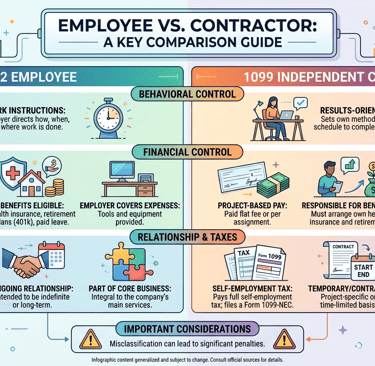
Download the quick reference guide and infographic.
contact@convergusva.com
616-795-0928
© 2026 ConvergusVA. All rights reserved.
Call us:
Email us:
Follow us:
Your virtual business partner
Disclaimer: We are neither a licensed tax nor accounting firm and do not provide tax advice. Additionally, we are not a staffing agency or a Professional Employer Organization (PEO) and cannot offer legal guidance. For legal inquiries, please seek advice from a licensed employment law attorney.
Quick Links