Business Owner’s Guide: New CMV English Proficiency Standards
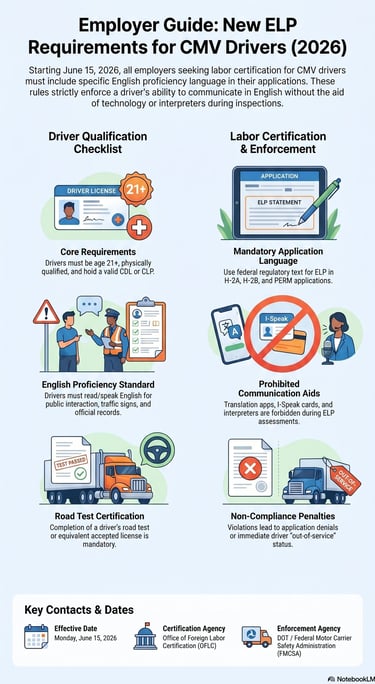
Effective June 15, 2026, the U.S. Department of Labor (DOL) requires all employers seeking foreign workers for Commercial Motor Vehicle (CMV) positions to explicitly state English Language Proficiency (ELP) requirements in their job orders. This applies to H-2A, H-2B, CW-1, and PERM (permanent) labor certification programs.
EMPLOYMENT LAW & COMPLIANCE
5/22/20263 min read


The Big Change
Effective June 15, 2026, the U.S. Department of Labor (DOL) requires all employers seeking foreign workers for Commercial Motor Vehicle (CMV) positions to explicitly state English Language Proficiency (ELP) requirements in their job orders. This applies to H-2A, H-2B, CW-1, and PERM (permanent) labor certification programs.
Who Is a Qualified Driver?
To legally operate a CMV in interstate commerce, a driver must:
Be at least 21 years old.
Speak and read English well enough to talk to the public, understand road signs, respond to official questions, and keep records.
Hold a valid CMV license from one jurisdiction (a learner's permit counts if they are accompanied by a CDL holder).
Pass a physical exam and a road test.
Note: These rules apply to all interstate CMV drivers, even if they are in an industry (like agriculture) that is exempt from CDL requirements.
The New "No Tools" Rule
Drivers are strictly prohibited from using translation apps, smart phones, interpreters, or "I-Speak" cards during roadside English assessments. Using these tools is now considered a way to mask an inability to communicate in English and will result in a failure.
Mandatory Job Language
To avoid application denials, you must include this specific standard in your job orders:
"The worker must be able to read and speak the English language sufficiently to converse with the general public, understand highway traffic signs and signals in English, respond to official inquiries, and make entries on reports and records".
To prepare for the June 15, 2026, deadline, business owners must ensure their labor certification filings and recruitment processes align with the newly mandated English Language Proficiency (ELP) standards.
The following steps are recommended based on the FAQ issued by the Department of Labor:
1. Update Job Orders and Labor Certification Applications
Starting June 15, 2026, any application for temporary (H-2A, H-2B, CW-1) or permanent (PERM) labor certification for a CMV position must include an express ELP standard.
Use Mandatory Language: Your job postings should use language consistent with 49 C.F.R. § 391.11(b)(2). The sources suggest the following compliant statement: "The worker must be able to read and speak the English language sufficiently to converse with the general public, understand highway traffic signs and signals in English, respond to official inquiries, and make entries on reports and records".
Avoid Immediate Denials: Ensure this language is present to avoid a Notice of Deficiency for temporary programs or an immediate denial for PERM applications.
2. Implement Enhanced Driver Screening
While not mandatory, the Department of Labor suggests employers take extra steps to ensure prospective foreign workers can meet roadside ELP assessments.
Assess Technical Communication: Screen applicants on their ability to answer questions in English regarding logbooks, drive time, trip information, and shipping papers.
Test Signage Recognition: Verify that candidates can explain the meaning of U.S. highway signs, such as those found in the Manual on Uniform Traffic Control Devices (MUTCD).
Prohibit Translation Aids: Formally advise applicants that they will not be permitted to use translation apps, interpreters, or "I-Speak" cards during official ELP assessments.
3. Review Operational Scope
Agriculture and Exemptions: Even if your operations are exempt from Commercial Driver’s License (CDL) requirements (common in the agricultural industry), your drivers must still meet ELP standards if they operate a CMV in interstate commerce.
Check Existing Staff: Ensure current drivers are aware of the strict enforcement policy where failing an ELP assessment results in being placed out-of-service and potentially disqualified.
4. Consult with Relevant Agencies
Because the Department of Labor only handles the labor certification aspect, you should stay informed on additional requirements from other agencies:
Department of State: For evidentiary ELP requirements related to visa issuance.
DOT/FMCSA: For updates on internal enforcement policies and driver qualification standards.
What Happens If You Don't Comply?
For Your Business: Missing the ELP language in your application will lead to a Notice of Deficiency or an immediate denial of your labor certification.
For Your Drivers: If a driver fails an English check on the road, they will be cited and placed "out-of-service" (meaning they cannot continue driving), and may be disqualified from driving CMVs entirely.
Contact Information & Resources
For Labor Certification Questions: Contact the Office of Foreign Labor Certification (OFLC).
For Roadside Enforcement Rules: Contact the Department of Transportation (DOT) or Federal Motor Carrier Safety Administration (FMCSA).
For Visa Petitions: Contact the U.S. Department of State.
For Road Sign Reference: See the Manual on Uniform Traffic Control Devices (MUTCD) at https://mutcd.fhwa.dot.gov/.
Source: Minimum Job Requirements for the Operation of Commercial Motor Vehicles (CMVs), U.S. Department of Labor, May 14, 2026.
Read the FAQs issued by the Department of Labor on the English language proficiency standard for commercial motor vehicle drivers.
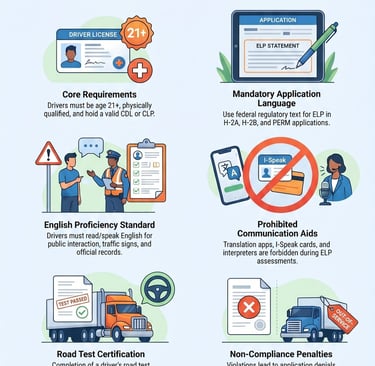
Download this infographic
contact@convergusva.com
616-795-0928
© 2026 ConvergusVA. All rights reserved.
Call us:
Email us:
Follow us:
Your virtual business partner
Disclaimer: We are neither a licensed tax nor accounting firm and do not provide tax advice. Additionally, we are not a staffing agency or a Professional Employer Organization (PEO) and cannot offer legal guidance. For legal inquiries, please seek advice from a licensed employment law attorney.
Quick Links